Lakers: The Powerful History, Greatest Players, Championships, and Future of the NBA’s Most Famous Team

The Lakers are one of the most recognizable names in professional basketball. For decades, the Los Angeles Lakers have combined elite talent, dramatic moments, championship success, and a huge global fan base. The team is known not only for winning games but also for creating basketball eras that changed the way the sport was played and watched.
The franchise has a history that stretches back far beyond Los Angeles. Before becoming the Los Angeles Lakers, the organization played in Minneapolis and established itself as one of the early powers of professional basketball. The franchise eventually moved to Los Angeles in 1960, where it developed into a worldwide sports brand.
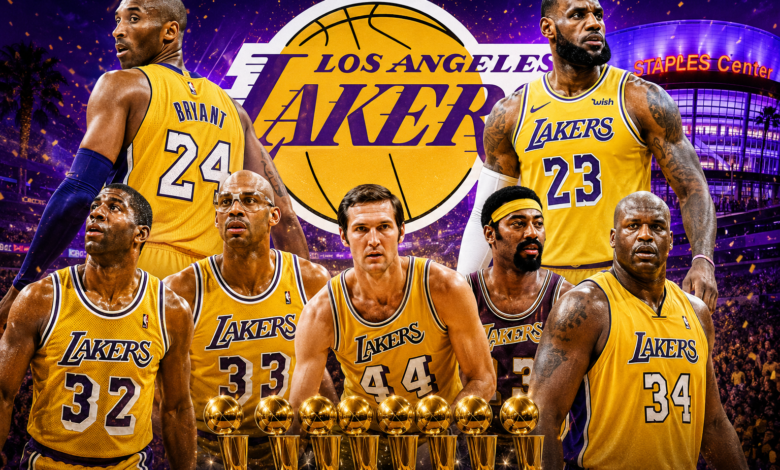
What makes the Lakers especially interesting is the number of legendary players who have worn the famous purple and gold. George Mikan, Jerry West, Wilt Chamberlain, Kareem Abdul-Jabbar, Magic Johnson, Shaquille O’Neal, Kobe Bryant, and LeBron James all played important roles in different chapters of the franchise. Each generation brought its own style and personality.
Today, the Lakers remain one of the NBA’s biggest attractions. Their history, passionate supporters, championship expectations, and constant search for the next superstar continue to keep the organization in the spotlight.
The Early History of the Lakers
The Lakers’ story began in Minneapolis, where the franchise became one of the earliest dominant teams in professional basketball. The team won five championships during its Minneapolis era, establishing a winning tradition before the move to California. The NBA’s official history records the Minneapolis Lakers as champions in 1949, 1950, 1952, 1953, and 1954.
George Mikan was the central figure of that early period. His size, scoring ability, and influence around the basket made him one of the most important players of the early NBA. The Lakers’ success during this period helped build the franchise’s identity as a team expected to compete for championships rather than simply participate in the league.
The move to Los Angeles in 1960 created an entirely new chapter. California provided a much larger entertainment market, and the Lakers eventually became closely connected with Hollywood, celebrities, and the culture of Los Angeles. That combination helped turn the team into something much bigger than a traditional sports franchise.
Although the early Los Angeles years included disappointment in the NBA Finals, the organization continued attracting exceptional talent. Players such as Elgin Baylor and Jerry West helped establish the Lakers as a major Western Conference force. Their performances laid the foundation for the championship eras that followed.
Lakers Championships and Winning Tradition
Championships are arguably the biggest reason the Lakers are considered one of basketball’s greatest franchises. According to the NBA’s official Lakers records, the franchise has won championships across several different eras, including titles in Minneapolis and Los Angeles. The official championship list includes 1949, 1950, 1952, 1953, 1954, 1972, 1980, 1982, 1985, 1987, 1988, 2000, 2001, 2002, 2009, 2010, and 2020.
The 1971-72 Lakers created one of the most remarkable regular seasons in NBA history. They won 69 games and produced a 33-game winning streak, which remains one of the most famous winning streaks in professional sports. Wilt Chamberlain, Jerry West, Gail Goodrich, and their teammates eventually completed the season by winning the NBA championship.
The 1980s brought another spectacular championship period. Led by Magic Johnson, Kareem Abdul-Jabbar, James Worthy, and an outstanding supporting cast, the Lakers developed the famous “Showtime” identity. Fast-paced offense, creative passing, spectacular fast breaks, and tremendous individual talent made the team one of the most entertaining groups in NBA history.
The franchise later produced another dynasty during the early 2000s. Shaquille O’Neal and Kobe Bryant became the centerpiece of the Lakers, with Phil Jackson guiding the team from the sidelines. Los Angeles won three consecutive championships from 2000 through 2002, creating another unforgettable period in the franchise’s history.
The Showtime Lakers Era
The Showtime Lakers changed how basketball could look on television. Magic Johnson’s extraordinary passing ability was at the heart of the team’s style. Instead of slowing the game down whenever possible, the Lakers frequently pushed the ball quickly and turned defensive rebounds into fast offensive opportunities.
Kareem Abdul-Jabbar provided a completely different dimension. His skyhook became one of the most recognizable shots in basketball history, while his size and efficiency gave the Lakers a reliable scoring option in the half court. The NBA’s Lakers history notes that Abdul-Jabbar joined Los Angeles in 1975 and later became a central figure in the franchise’s championship success.
Magic and Kareem were surrounded by players who understood their roles. James Worthy became another major offensive weapon, while players such as Byron Scott and Michael Cooper contributed scoring, defense, and athleticism. Together, they created a balanced team capable of playing both spectacular offense and disciplined basketball.
The 1980s Lakers won five championships during the decade. Their success reached another level in 1988 when Los Angeles defeated the Detroit Pistons to win consecutive championships. According to NBA history, the Lakers became the first NBA team in 20 years to win back-to-back titles.
Kobe Bryant and the Lakers Dynasty
Kobe Bryant’s connection with the Lakers became one of the defining stories of modern basketball. Bryant entered the NBA as a teenager and eventually developed into one of the league’s most skilled and competitive players. His career in Los Angeles lasted two decades and made him synonymous with the franchise.
The partnership between Kobe Bryant and Shaquille O’Neal produced extraordinary results. O’Neal was a dominant interior force, while Bryant could create shots from almost anywhere on the court. Their different strengths made the Lakers extremely difficult to defend.
The Lakers won championships in 2000, 2001, and 2002 during that era. The organization later experienced changes, but Bryant remained the central figure of the franchise. He eventually won two additional championships with Los Angeles in 2009 and 2010, cementing his place among the most important Lakers ever. The NBA’s official records list all five of those championships among the franchise’s title seasons.
Bryant’s impact went beyond statistics. His famous work ethic, competitive mentality, difficult shot-making, and commitment to improvement influenced a generation of basketball players. For many fans, the Lakers and Kobe Bryant became inseparable parts of the same basketball story.
LeBron James and the 2020 Lakers Championship
LeBron James brought another superstar chapter to Los Angeles when he joined the Lakers in 2018. His arrival immediately changed the team’s expectations because James had already established himself as one of the greatest players in NBA history.
The Lakers eventually paired James with Anthony Davis, creating a powerful inside-out combination. Davis provided elite defense, rebounding, scoring, and versatility, while James continued to serve as a primary creator and offensive engine.
The 2019-20 season became one of the strangest and most memorable seasons in NBA history. The coronavirus pandemic interrupted the campaign, and the league eventually completed the season in the Orlando bubble. The Lakers navigated the unusual environment and defeated the Miami Heat in the NBA Finals.
That championship became the franchise’s 17th title and gave the Lakers another championship moment in a completely different era. NBA.com describes the 2020 title as a particularly difficult achievement because of the pandemic, the season shutdown, and the emotional challenges surrounding the team.
Lakers Legends Who Changed Basketball
The Lakers have been home to an extraordinary collection of basketball legends. George Mikan helped establish the franchise during its Minneapolis years, while Jerry West became one of the defining figures of the team’s early Los Angeles period. West’s scoring ability, competitiveness, and leadership made him a legendary figure in Lakers history.
Wilt Chamberlain also played an important role for Los Angeles. His 1971-72 season demonstrated how a superstar could impact winning without simply chasing scoring numbers. Chamberlain averaged 14.8 points and 19.2 rebounds during that championship campaign while contributing tremendous defensive value and team-oriented play.
Kareem Abdul-Jabbar became another essential Lakers legend. He arrived in Los Angeles in 1975 and continued performing at an elite level for many years. His scoring, rebounding, defense, and longevity helped him become one of the greatest centers the league has ever produced.
Then came Magic Johnson and Kobe Bryant, two players who represented different generations but shared a remarkable connection with Lakers fans. Magic embodied Showtime basketball, while Bryant represented relentless competitiveness. Later, LeBron James added his own historic chapter. The sheer number of legendary players associated with the Lakers explains why the organization carries such enormous expectations.
The Modern Lakers and the End of the LeBron Era
The modern Lakers have gone through several different stages since their 2020 championship. After winning the title, the team dealt with injuries, roster changes, playoff disappointments, and the normal difficulty of maintaining a championship-level group in the NBA.
The 2023-24 Lakers finished 47-35 and reached the playoffs, while the 2024-25 team improved to 50-32. However, the official season records show that both teams were eliminated in the Western Conference first round.
The organization entered another major transition in 2026 when LeBron James’ Lakers chapter came to an end. NBA.com reported in June 2026 that James planned to play elsewhere for the 2026-27 season, ending his eight-year run with Los Angeles. His Lakers career included the 2020 championship and numerous individual milestones.
That departure naturally creates a new question for the franchise: what comes next? The Lakers have historically responded to major transitions by searching for elite talent. Their ability to attract stars, develop players, make major trades, and maintain a championship culture will be closely watched as the next era develops.
The Lakers’ Current Direction and Future
The Lakers entered the 2025-26 period with JJ Redick as head coach and Rob Pelinka as general manager, according to the team’s official historical records. The same records list Mark Walter as the team’s owner for the 2025-26 season.
The future will depend heavily on roster construction. Losing a player of LeBron James’ caliber creates a major basketball challenge, but it also gives the organization an opportunity to reshape the roster around younger talent and new leadership. Building a sustainable contender is usually more complicated than simply adding one famous player.
The Lakers also continue to invest attention in younger players and prospects. Their 2026 Summer League roster included first-round pick Cameron Carr, 2025 second-round selection Adou Thiero, and several players with experience in the Lakers’ development system.
That development pathway matters because successful NBA organizations need more than superstar names. They need players who can defend, shoot, rebound, create plays, and contribute without dominating the ball. If the Lakers can combine young talent with experienced leadership, the organization could build another competitive chapter.
Why the Lakers Remain So Popular
The Lakers’ popularity comes from a combination of basketball success, famous players, Los Angeles culture, and decades of memorable moments. A Lakers game can attract attention from serious basketball fans and casual viewers alike. The purple-and-gold identity is recognizable far beyond the United States.
Another reason is the franchise’s ability to continually produce stories. From the Minneapolis championships to the Showtime years, from Kobe Bryant’s legendary career to the 2020 title, there is almost always another chapter worth discussing.
The team’s celebrity connections also contribute to its unique image. Los Angeles is one of the world’s major entertainment centers, and Lakers games have long attracted actors, musicians, athletes, business leaders, and other public figures. That visibility helps keep the team in popular culture even when the basketball season is over.
Most importantly, Lakers fans expect success. That expectation can create pressure, but it can also motivate the organization. The franchise’s history includes 18 championship seasons listed by the NBA, giving supporters plenty of reasons to believe that another great era could eventually arrive.
Lakers Records, Statistics, and Historical Achievements
The Lakers’ individual records demonstrate how many extraordinary players have passed through the organization. Kobe Bryant holds the franchise’s all-time scoring record with 33,643 points, according to NBA.com. Magic Johnson leads the Lakers in assists with 10,141, while Elgin Baylor holds the franchise rebounding record with 11,463 rebounds.
Kareem Abdul-Jabbar holds the Lakers’ all-time blocks record with 2,694, while Kobe Bryant also owns the franchise’s steals record with 1,944. These numbers highlight how different eras produced different types of legendary contributors.
The team’s championship history is equally impressive. The franchise has won titles in multiple eras and under very different styles of basketball. Early Lakers teams relied heavily on dominant interior play, the Showtime teams emphasized speed and passing, while later championship groups demonstrated the value of two-way superstar talent and defensive versatility.
The Lakers have also produced numerous memorable regular seasons. The 1971-72 team, for example, won 69 games and established a 33-game winning streak. That season remains one of the strongest examples of sustained dominance in NBA history.
What Makes the Lakers Different From Other NBA Teams?
Many NBA franchises have experienced periods of greatness, but the Lakers have repeatedly managed to create new eras. That consistency is one of the most unusual aspects of the organization. The team has had successful periods separated by rebuilding years, yet it has repeatedly returned to championship contention.
The franchise’s appeal to superstar players is another important factor. Los Angeles offers a massive sports market, global recognition, and a unique entertainment environment. For an NBA star, playing for the Lakers can become part of a much larger personal and professional story.
The organization also has an unusually deep basketball history. A young fan might discover the Lakers through a current player, then learn about Kobe Bryant, Magic Johnson, Kareem Abdul-Jabbar, Jerry West, Wilt Chamberlain, or George Mikan. Every generation provides another entry point into the team’s story.
Ultimately, the Lakers are more than a basketball team. They represent decades of competition, famous personalities, championship celebrations, heartbreaking losses, and unforgettable performances. That combination explains why the word “Lakers” continues to carry so much weight in professional basketball.
Final Thoughts on the Lakers
The Lakers have built one of the richest histories in sports. Their journey from Minneapolis to Los Angeles produced championship teams, legendary players, iconic coaches, and some of the most memorable moments in NBA history.
The franchise has experienced dominant dynasties as well as difficult rebuilding periods. Yet the expectations have remained remarkably consistent. Lakers fans want their team to compete for championships, and the organization has repeatedly attempted to meet those expectations by pursuing elite talent and developing new stars.
The end of the LeBron James era marks another important transition. After eight seasons in Los Angeles and a championship in 2020, the franchise now faces the challenge of establishing its next identity. The future will depend on roster decisions, player development, coaching, and the ability to identify the next generation of difference-makers.
That uncertainty is also what makes the Lakers fascinating. Every new season brings another possibility. The team has already experienced so many different eras that another transformation would be completely consistent with its history. Whether the next chapter becomes another dynasty or a longer rebuilding process, the Lakers will remain one of the NBA’s most watched and discussed franchises.