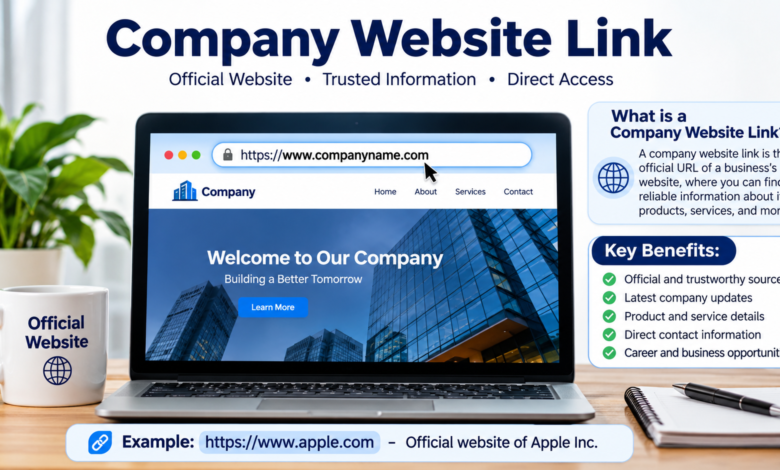
What Is a Company Website Link?
A company website link is the web address that directs people to a business’s official website. It may appear as a simple URL, such as companyname.com, or as clickable text such as “Visit Our Website.” In most cases, the link takes visitors to the company’s homepage, where they can learn about its products, services, team, contact details, and overall brand.
At first glance, a website link seems like a small piece of information. In reality, it plays a major role in how customers interact with a business online. When someone searches for a company, they usually want a quick and reliable way to reach the official source. A correct website link removes unnecessary steps and gives the visitor a direct path to the information they need.
A company website link can also appear in many different places. Businesses commonly add it to social media profiles, business directories, Google Business Profiles, email signatures, online listings, advertisements, digital brochures, and professional profiles. LinkedIn company pages, for example, can provide a website field that helps people move from a company profile directly to its official site.
The important thing is that the link should point to the official and current website. An outdated URL, broken link, incorrect domain, or unofficial page can create confusion and make a business appear less trustworthy. That is why companies should regularly check important website links and update them whenever their domain, website structure, or online presence changes.
Why Is a Company Website Link Important for a Business?
A company website link gives customers a direct connection to a business. Instead of asking people to search for the company manually, businesses can provide one clear path to their official website. This is especially useful when customers are discovering a brand through social media, search engines, directories, advertisements, or professional networks.
Trust is another important reason. Customers naturally want to know whether they are dealing with the real company. A properly branded website can provide information that third-party profiles cannot always offer. The official site may contain company information, product descriptions, policies, contact information, support resources, and other details that help visitors decide whether the business is legitimate.
A website link can also support business performance. Research into links to business websites has found that hyperlinks can carry useful business information and that links to company websites are often created for business purposes. This makes the company website link more than just a navigation tool. It can become part of a broader digital marketing strategy.
There is also a practical advantage. When a company has a consistent official website link across its online profiles, customers can move between platforms more easily. Someone might discover a brand on LinkedIn, read a post on Facebook, see a listing in a business directory, and eventually visit the company’s website. A consistent URL makes that journey smoother and more professional.
How to Find a Company Website Link
Finding a company website link is usually simple when the business has an established online presence. The first method is to search the exact company name in a search engine. Adding the company’s location, industry, or product can make the search more precise when several businesses have similar names.
However, you should not automatically assume that the first result is the official website. Search results can contain directories, review platforms, social media pages, news articles, competitors, and advertisements. A better approach is to compare the company name, logo, description, location, and other identifying information before deciding that a domain belongs to the business.
LinkedIn can also be a useful source, particularly for B2B companies. A company page may include a dedicated website field, making it possible to move directly from the business profile to its website. If you start from an employee’s LinkedIn profile, you can sometimes click the employer listed in the person’s experience section and then locate the company’s website from the company page.
Social media profiles are another useful place to check. Businesses often place their official website in their profile biography or contact section. You can compare the domain shown on several official-looking profiles. If LinkedIn, Instagram, Facebook, and the company’s Google presence all point toward the same domain, that gives you a stronger indication that you have found the correct website.
How to Verify an Official Company Website Link
Finding a website is only half the job. The next step is verifying that it actually belongs to the company you are researching. This matters because many businesses share similar names, and some websites may look convincing even when they are unrelated to the organization you want.
Start by checking the website itself. Look for the company name, logo, contact information, physical location, products, services, and other identifying details. Compare these details with information from reliable business profiles. If the website claims to represent a company in one industry but the company’s verified profiles describe a completely different business, you may have found the wrong domain.
You should also check whether the website uses a professional domain. A business may use .com, .co, .org, .net, .io, .ai, or another extension depending on its brand and industry. The domain extension alone does not prove whether a site is legitimate. What matters more is whether the website consistently matches the company’s established identity and information.
For more important research, such as business partnerships or due diligence, additional verification can be useful. Domain registration information, official social profiles, company directories, and business records can provide additional clues. A recent guide to finding company domains recommends using multiple signals, including exact-name searches, knowledge panels, LinkedIn, social profiles, and domain ownership checks when necessary.
Company Website Link vs. Company Website URL
People often use the terms company website link and company website URL interchangeably, but there is a small difference. A URL is the actual web address, while a link is the clickable connection that takes someone to that address.
For example, example.com is a URL. If the words “Visit Example Company” are clickable and take users to example.com, those words function as a link. The visible text and the underlying URL do not necessarily have to be identical.
This distinction becomes important when businesses create marketing materials. A company might use branded anchor text instead of displaying a long web address. Rather than showing a complicated URL, a business can use simple text such as “Official Company Website.” This can make a page cleaner and easier for visitors to understand.
Website links can also lead to specific pages instead of the homepage. These are commonly called deep links. For example, a company listing could link directly to a product page, service page, pricing page, or contact page. IndustryNet introduced a deep-linking feature in 2026 that allows company listings to connect visitors directly with relevant product and service pages instead of sending everyone to the homepage.
Where Should a Company Website Link Be Used?
A company website link can be placed almost anywhere customers may encounter the business online. One of the most obvious locations is the company’s social media profile. Adding the official website allows followers to move from a social platform to a business-owned destination with a single click.
Professional profiles are equally useful. Companies can add their website to LinkedIn, business directories, industry databases, marketplace profiles, and other relevant platforms. These links make it easier for potential customers, suppliers, journalists, investors, and business partners to learn more about the organization.
Email is another important location. A company’s email signature can include a website link alongside the business name and contact details. This is especially useful because every ordinary business conversation can become an opportunity for someone to discover the company website.
Businesses should also consider links in digital documents and marketing materials. Brochures, presentations, newsletters, invoices, press releases, advertisements, and downloadable guides can all direct readers toward the official website. The goal is simple: whenever someone needs more information, the company website should be easy to reach.
How Company Website Links Help With SEO
A company website link can support SEO when it is placed on relevant and trustworthy websites. Search engines use many signals to understand websites and their relationships across the web. Links can contribute to discovery, referral traffic, and the overall online presence of a business.
However, simply creating hundreds of random links is not a good SEO strategy. Quality and relevance matter. A link from a legitimate industry website can be much more useful than a large number of unrelated links created only for search engine manipulation.
Internal links are also important. Once visitors reach a company website, links between relevant pages help them discover more information. A homepage can link to services, services can link to detailed offerings, and product pages can connect visitors to related products or contact pages.
External links can bring another benefit: referral traffic. Someone reading an industry article may click a company website link because they want to learn more. That visitor is already interested in the subject, which can make referral traffic particularly valuable. The objective should therefore be to create useful connections rather than simply collect links.
Common Mistakes When Using a Company Website Link
One of the most common mistakes is using an outdated website address. Businesses sometimes change domains, redesign websites, or move pages without updating their profiles. When customers click an old link and encounter an error page, they may assume the company is no longer active.
Another mistake is linking to the wrong website. This can happen when multiple businesses share similar names. A quick search may produce several companies with almost identical branding. Always compare the domain with the company’s location, industry, official profiles, and other identifying information before publishing the link.
Businesses can also make the mistake of sending everyone to the homepage. The homepage is useful, but it is not always the best destination. If someone is looking for a specific service, sending them directly to that service page can save time and improve the user experience. Deep links are particularly helpful for this purpose.
Another issue is inconsistent URLs. A business might use one domain on LinkedIn, another on Facebook, and an old domain on its directory listings. Even when redirects exist, keeping important profiles consistent makes the brand easier to recognize and reduces confusion.
How to Create a Professional Company Website Link
Creating a professional company website link starts with choosing the correct destination. For general brand awareness, the homepage is usually the natural choice. For a specific campaign, however, a dedicated landing page may produce better results because it takes visitors directly to relevant information.
The visible anchor text should also be clear. Instead of using confusing phrases, businesses can use descriptive wording such as “Official Website,” “Visit Our Website,” “Explore Our Services,” or the company’s brand name. The best choice depends on the context and the purpose of the link.
The link should work properly on both desktop and mobile devices. A website that loads slowly, displays incorrectly, or redirects users through unnecessary pages can create a poor first impression. Businesses should periodically test their important links to make sure they still reach the intended destination.
It is also worth keeping a record of the company’s primary domain. This simple practice can help teams maintain consistency across social media, business directories, advertising campaigns, email signatures, and other digital channels. When everyone uses the same official website address, the company presents a much more organized online identity.
Company Website Link for Small Businesses
Small businesses sometimes underestimate the importance of having a clear company website link. A local business may receive most of its customers through search engines, social media, referrals, or maps, but its website still provides an important central location for information.
For a small company, the website can answer common customer questions before someone ever makes a phone call. Visitors can check opening hours, services, pricing information, contact details, locations, frequently asked questions, and other useful information.
A consistent company website link can also make a small brand look more established. When the same official domain appears across business profiles and marketing materials, customers get a clearer impression of the brand. It also makes the business easier to find when people search for it by name.
Most importantly, small businesses should avoid overcomplicating the process. A clean domain, functional website, clear navigation, accurate information, and consistent links can go a long way. The website does not have to be enormous to be effective; it needs to serve the people who visit it.
Final Thoughts on Company Website Links
A company website link may look like a simple URL, but it is an important part of a business’s digital identity. It connects customers with the official website and creates a direct route to products, services, company information, and contact details.
Finding the right link requires more than clicking the first search result. Businesses and researchers should verify the company name, domain, branding, location, and other identifying information. LinkedIn, social profiles, search engines, directories, and other reliable sources can all help confirm the correct website.
For businesses, maintaining accurate website links is just as important as creating them in the first place. An outdated or broken link can frustrate potential customers, while a well-maintained link can make the entire online experience feel smoother and more professional.
Ultimately, the best company website link is one that is accurate, trustworthy, relevant, easy to access, and connected to the right destination. Whether it appears on a social profile, business listing, email signature, search result, or industry directory, that small link can become an important doorway between a company and its audience.