The New York Times Strands: How to Play, Solve Puzzles, and Master the Daily Word Game

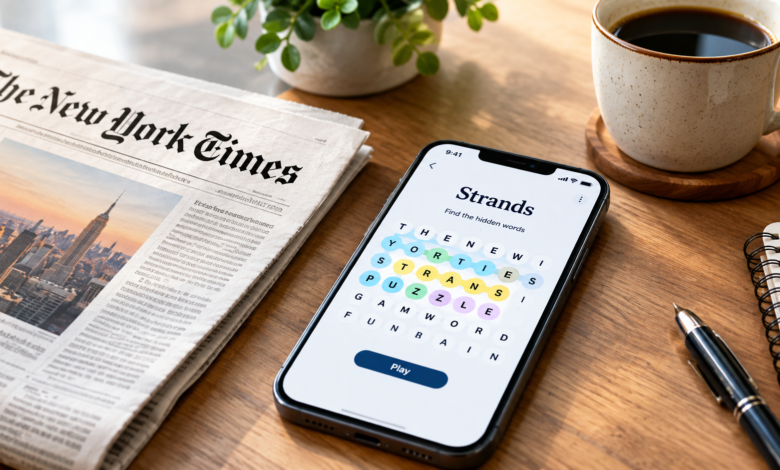
The New York Times Strands has quickly become one of those daily puzzles that looks simple until you actually sit down and try to solve one. At first glance, it resembles a traditional word search. You see a grid packed with letters and assume the goal is simply to find hidden words.
That assumption lasts about thirty seconds.
Unlike an ordinary word search, The New York Times Strands asks you to think about relationships between words rather than simply spotting familiar letter patterns. Every puzzle has a hidden theme, and the words you discover must connect to that theme. The real challenge is figuring out what the puzzle wants you to see before the grid starts making sense.
The game is particularly appealing because it sits somewhere between a word search, a crossword, and a logic puzzle. You need vocabulary, pattern recognition, lateral thinking, and sometimes a little patience. A word can bend around the board, travel diagonally, and take a path that feels completely unexpected.
The most important word in the puzzle is often the spangram. Finding it can suddenly make the entire board easier because it reveals what the puzzle is really about. Once the theme clicks, letters that looked random can start looking like pieces of a larger picture.
That combination makes The New York Times Strands satisfying for both casual players and serious puzzle fans. You do not necessarily need an enormous vocabulary to succeed. You need to learn how the puzzle is constructed and develop a reliable way of approaching each board.
If you are new to the game, this guide explains everything from the basic rules to advanced solving techniques. If you already play every day, you may still find a few strategies that make difficult puzzles less frustrating.
What Is The New York Times Strands?
The New York Times Strands is a daily word puzzle built around a hidden theme. Instead of giving you a list of words to locate, the game gives you a theme clue and a grid of letters. Your job is to discover the words that belong to that theme.
The grid uses a compact 6-by-8 arrangement, giving you 48 letters to work with. That sounds manageable, but the lack of a traditional word bank changes everything. You are not searching for words that have already been provided. You are searching for words that you believe belong to a category you are still trying to understand.
This creates an interesting mental loop. The theme helps you identify possible answers, but the answers also help you understand the theme. You might recognize one word first and then realize that several other apparently unrelated words suddenly make sense.
For example, imagine the theme suggests something connected to a particular type of food. You may initially search for obvious food names. But the puzzle might actually be looking for kitchen tools, ingredients, cooking techniques, or famous dishes. The wording of the theme is therefore extremely important.
Words are formed by connecting adjacent letters. You can move horizontally, vertically, or diagonally, and the path can change direction. That freedom is one of the biggest differences between The New York Times Strands and conventional word-search puzzles.
Another important feature is that the puzzle is designed so the letters have a purpose. Once you understand that nearly every part of the board contributes to the completed solution, the unused letters become clues rather than meaningless leftovers. Instead of asking, “What word can I find here?” you can start asking, “What answer could these remaining letters possibly form?”
The game also includes a special answer called the spangram. It summarizes the theme and stretches from one side of the board to the opposite side. Discovering it is often the breakthrough moment because it gives you a much clearer picture of what the puzzle is asking.
How to Play The New York Times Strands
Starting a The New York Times Strands puzzle is straightforward. You first read the theme clue displayed above the letter grid. Do not rush past it. That short phrase is essentially your roadmap, even when it feels vague or playful.
Next, examine the grid and look for possible words connected to the theme. When you see a promising sequence, connect the letters by dragging across them. The letters must be adjacent, but adjacency includes diagonal movement, which gives you far more possible paths than a traditional horizontal-and-vertical word search.
You can also change direction during a word. A correct answer might travel upward, turn diagonally, move sideways, and then curve downward. This is why experienced players avoid assuming that a word must follow a straight line.
When you submit a correct theme word, the game identifies it as part of the solution. This gives you valuable information because you now know which letters have been accounted for and which parts of the grid remain unexplained.
You should not become discouraged when you discover ordinary words that are unrelated to the theme. Those words can actually be useful. The puzzle’s hint system rewards players for finding valid non-theme words, so experimenting with the grid can be part of a sensible solving strategy.
The goal is ultimately to find all the theme-related words and the spangram. As the board fills, the remaining letters become increasingly informative. A difficult puzzle often becomes easier toward the end because there are fewer possibilities left.
The biggest beginner mistake is treating The New York Times Strands like a normal word search. Instead, treat it as a theme-driven word puzzle. The letters matter, but the relationship between the words matters even more. Once you adopt that mindset, the game becomes much easier to understand.
Understanding the Spangram in NYT Strands
The spangram is arguably the most important concept to learn if you want to become better at The New York Times Strands. It is the special answer that describes or identifies the puzzle’s overall theme and stretches between two opposite sides of the grid.
Think of the spangram as the backbone of the puzzle. The other answers are usually connected to the category that the spangram establishes. If you can identify it early, you may suddenly know exactly what kind of words you should be searching for.
Finding the spangram is not always easy, though. Because it can take an unusual route across the board, you may overlook it even when several of its letters are sitting in front of you. The fact that it can bend and change direction makes visual scanning especially important.
One useful technique is to think about the theme before trying to trace anything. Ask yourself what broad phrase could summarize the clue. If the theme appears to involve animals, for instance, consider whether the puzzle might actually be about animal sounds, fictional animals, breeds, habitats, or something more specific.
The spangram does not necessarily look like an ordinary answer from the perspective of the theme. It often represents the category itself rather than being just another member of that category. This distinction can help you narrow down possibilities.
Another strategy is to inspect the edges of the board. Because the spangram must touch opposite sides, edge letters can provide useful starting points. You do not need to trace every possible combination, but you can look for promising long words that could logically connect two opposing edges.
Do not become obsessed with finding the spangram immediately, however. Sometimes another theme word will reveal the category first. Once you discover one or two strong answers, return to the spangram with the new information. What initially looked impossible may suddenly become obvious.
Best Strategies for Solving The New York Times Strands
The first strategy is simple: read the theme carefully. Many players make the mistake of looking at the grid immediately and ignoring the clue. That is like attempting a crossword while refusing to read the clues. The theme exists to reduce the enormous number of possible words.
Start by brainstorming related vocabulary mentally. If the clue suggests movies, do not limit yourself to movie titles. Consider actors, characters, genres, locations, objects, phrases, or anything else that could reasonably connect to the wording.
Next, look for longer words. Longer answers are often easier to recognize because they contain more distinctive letter sequences. A short word can blend into dozens of possible paths, while a longer word may reveal itself through a unique combination of letters.
You should also experiment with diagonal movement. New players often search horizontally and vertically because that feels natural. In The New York Times Strands, however, diagonals are essential. If you see a promising beginning but cannot continue in a straight direction, try turning.
Another useful habit is to revisit the board after every discovery. Finding one answer changes the puzzle. You now know that those letters are accounted for, and you may have learned something about the theme. The best solving process is therefore dynamic rather than repetitive.
Pay attention to unusual letter clusters. If several letters seem awkwardly positioned, they may be deliberately arranged to form part of a longer answer. The New York Times Strands frequently requires you to stop thinking in terms of rows and columns and start thinking in terms of connected shapes.
Finally, use elimination. Once several theme words have been found, ask what category members are still missing. The remaining letters may contain an answer that you would never have considered at the beginning. This is especially helpful on puzzles with broad or ambiguous themes.
How The New York Times Strands Hint System Works
The built-in hint system is one of the reasons The New York Times Strands can remain enjoyable even when a puzzle becomes difficult. Rather than immediately giving away the entire answer, the game allows you to earn assistance by finding words that are valid but unrelated to the theme.
Typically, three qualifying non-theme words can earn a hint. This creates an interesting incentive to explore the board instead of staring at the same difficult section indefinitely.
When you use a hint, the game helps identify a hidden theme word. The assistance is designed to move you forward without necessarily doing all the thinking for you. You still have an opportunity to recognize the word and work out its path.
This is a much better experience than simply looking up the complete answer every time you get stuck. A full solution ends the puzzle immediately. A hint can preserve some of the discovery process, which is often the most enjoyable part of The New York Times Strands.
You should also understand that hints are not something to be embarrassed about. Even experienced puzzle players encounter boards built around obscure references, unusual word choices, or clever themes. A hint can simply provide the nudge required to restart your reasoning.
If you want to improve your skills, try delaying the hint until you have genuinely exhausted your ideas. Spend a few minutes searching for obvious words, examining the edges, considering the spangram, and thinking of alternative interpretations of the theme.
There is also a useful psychological benefit to the hint system. It encourages experimentation. Instead of worrying that every wrong attempt is damaging your game, you can treat the board as something to investigate. That relaxed attitude often leads to discoveries you would miss if you were afraid of making mistakes.
The best approach is to use hints strategically rather than automatically. Try to solve the theme yourself first, use ordinary discoveries to earn assistance when necessary, and then continue solving with the new information. That way, the hint becomes part of your learning process rather than a replacement for it.
Common The New York Times Strands Mistakes to Avoid
One of the most common mistakes is searching for words before understanding the theme. A player might find several perfectly valid English words and assume the puzzle is refusing to accept them. In reality, those words may simply have nothing to do with the intended category.
Another mistake is assuming that every answer travels in a straight line. The New York Times Strands is designed specifically to make you think about connected paths. If you only scan rows and columns, you are ignoring one of the most important mechanics of the game.
Players also sometimes become too focused on individual letters. Looking at one letter at a time can make the board feel chaotic. Instead, look for recognizable chunks, prefixes, suffixes, unusual combinations, and likely word shapes.
Ignoring the spangram is another costly habit. You do not always have to find it first, but you should keep it in mind. Because it reveals the theme’s central idea, it can dramatically reduce the number of possible answers you are considering.
Some players also give up too quickly after finding a few answers. The New York Times Strands can have a snowball effect. One discovery leads to another, which clarifies the theme, which then makes another answer obvious. A puzzle that feels impossible at the halfway point can suddenly become easy.
Another common problem is refusing to use hints because of pride. There is nothing wrong with asking for help when you are stuck. If your goal is to improve, think about why you were stuck and what the hint taught you. That is far more valuable than simply avoiding assistance.
Finally, do not assume that every puzzle will be equally difficult. Some themes will naturally match your vocabulary and interests. Others may involve cultural references or specialized knowledge that you rarely encounter. Difficulty can therefore depend as much on the theme as on your general puzzle-solving ability.
Why The New York Times Strands Is So Addictive
The biggest reason The New York Times Strands works so well is its sense of discovery. You are not simply checking answers against a list. You are uncovering a relationship between words, and that relationship gradually reveals itself as you play.
The game also creates small moments of satisfaction. Finding a hidden word feels good, but finding the word that explains the theme feels even better. Discovering the spangram can produce that classic puzzle-solving moment where several previously confusing details suddenly make sense.
Another strength is the flexibility of the gameplay. You can solve the puzzle slowly while drinking coffee, race through it during a break, or return to it later after thinking about the theme. There is no requirement that you approach every board in exactly the same way.
The New York Times Strands also rewards improvement. At first, you may spend a long time searching for obvious words. After playing regularly, you begin to recognize common construction patterns. You become more comfortable with diagonal paths, longer answers, unusual vocabulary, and theme-based reasoning.
The daily format adds another layer of motivation. Because a new puzzle arrives regularly, there is always another challenge waiting. It becomes easy to turn the game into a small daily ritual without needing a large time commitment.
For word-game fans, The New York Times Strands offers a different experience from other popular The New York Times Strands Times puzzles. Crossword puzzles emphasize clues and intersecting answers. Wordle focuses on narrowing down a single word. Connections asks players to identify groups of related words. Strands combines elements of these ideas while giving the player a visual grid to explore.
Most importantly, The New York Times Strands manages to be challenging without requiring perfection. You can experiment, make wrong guesses, earn hints, and keep going. That forgiving structure makes it accessible to beginners while still giving experienced players enough complexity to stay interested.
Final Thoughts on The New York Times Strands
The New York Times Strands is much more than a traditional word search with a new name. Its combination of hidden themes, flexible letter paths, thematic answers, and the spangram creates a puzzle that rewards both vocabulary and creative thinking.
If you are just starting, focus on understanding the theme before trying to conquer the entire grid. Look for longer words, remember that diagonal movement is allowed, and do not assume every promising English word belongs to the solution.
As you become more comfortable, start using the remaining letters as information. Every answer you find changes the shape of the puzzle. The unused portion of the board can tell you what is still missing.
Learning to recognize the spangram is another major step forward. You do not need to find it instantly, but understanding its role can give you a much clearer solving strategy.
Hints should be viewed as a tool rather than a failure. If you become genuinely stuck, use the game’s assistance and pay attention to what caused the difficulty. Over time, those difficult moments can teach you how The New York Times Strands thinks.
Ultimately, the appeal of The New York Times Strandscomes from that satisfying moment when the board suddenly makes sense. A collection of random letters becomes a group of related ideas, and the theme that seemed vague at the beginning becomes obvious.
That is why the game can keep pulling players back day after day. Each puzzle presents a new interpretation challenge, a new collection of words, and another opportunity to experience that small but rewarding feeling of figuring something out for yourself.