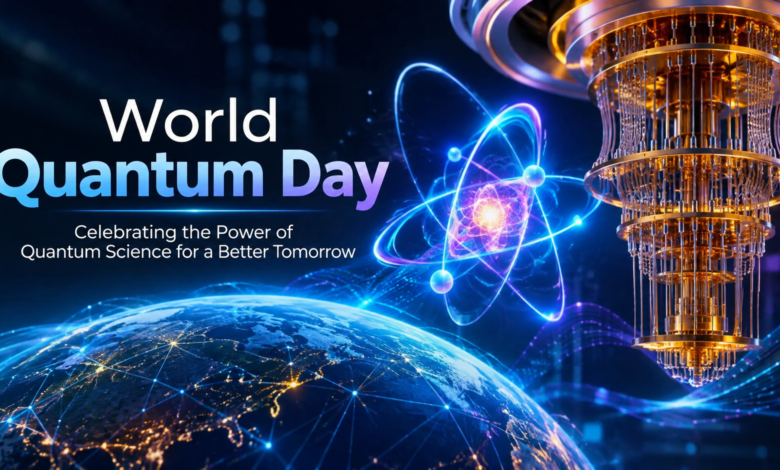
World Quantum Day: An Exciting Celebration of Quantum Science, Technology, World Quantum Day is celebrated every year on April 14.

Introduction to World Quantum Day
World Quantum Day is a global celebration dedicated to quantum science and the remarkable ideas that have changed our understanding of nature. It gives scientists, educators, students, technology enthusiasts, and curious members of the public an opportunity to explore what quantum science actually means and why it matters. Although quantum physics can sound complicated at first, its basic story is surprisingly fascinating.
Every year, World Quantum Day encourages people to learn about quantum mechanics and its growing influence on modern technology. The day also highlights the work of researchers who study particles, energy, information, and the unusual rules that operate at extremely small scales. From the computers we use to the technologies being developed for medicine and communication, quantum science has already influenced everyday life in ways many people do not realize.
The celebration is especially valuable because quantum technology is moving from university laboratories into real-World Quantum Day applications. Quantum computing, quantum communication, quantum sensing, and quantum materials are receiving significant attention from researchers and technology companies. World Quantum Day helps explain these developments without requiring everyone to be a physicist.
More importantly, the day encourages young people to become interested in science, technology, engineering, and mathematics. The quantum field needs future researchers, engineers, programmers, educators, and entrepreneurs. By making quantum concepts easier to understand, World Quantum Day can help inspire the next generation to explore one of the most exciting areas of modern science.
When Is World Quantum Day Celebrated?
World Quantum Day is celebrated every year on April 14. The date was selected because it can be associated with the approximate value of Planck’s constant, a fundamental constant in quantum physics, when expressed as 4.14 × 10⁻¹⁵ electronvolt seconds. This clever connection gives the celebration a scientific meaning rather than making it simply another date on the calendar.
The first World Quantum Day was observed in 2021. Since then, activities connected with the event have expanded internationally. Universities, research organizations, schools, museums, professional societies, and science communities have used the occasion to organize lectures, workshops, demonstrations, online events, and educational programs.
April 14 therefore represents more than a date for science enthusiasts. It provides an annual opportunity to discuss how quantum discoveries developed and where the field could go next. The event also creates a bridge between highly specialized scientific research and the general public.
For people discovering the subject for the first time, World Quantum Day is an excellent starting point. You do not need an advanced mathematics background to understand the major ideas. Learning a few basic concepts can make the subject much less intimidating and considerably more interesting.
What Is Quantum Science?
Quantum science is the study of physical systems at very small scales, including atoms, electrons, photons, and other microscopic particles. At this level, nature does not always behave according to the intuitive rules we experience in everyday life. Instead, particles can display behaviors that seem strange when compared with ordinary objects.
One important idea is quantization. In classical physics, we often imagine physical quantities changing continuously. Quantum physics shows that certain quantities can exist only in particular allowed states. This concept became central to the development of modern quantum mechanics.
Another fascinating feature is superposition. A quantum system can be described as being in a combination of possible states until a measurement is made. This does not mean that microscopic objects behave exactly like tiny versions of everyday objects. Rather, quantum systems are described using mathematical states that allow different possible outcomes.
Quantum science also includes concepts such as entanglement, uncertainty, wave-particle duality, and quantum tunneling. These ideas may sound unusual, but they have been repeatedly tested through experiments. World Quantum Day helps people appreciate that quantum physics is not science fiction. It is a highly successful scientific framework with practical consequences.
Why Is World Quantum Day Important?
World Quantum Day matters because quantum science is becoming increasingly relevant to technology and society. Many people hear terms such as quantum computer or quantum encryption but may not understand what they actually mean. A dedicated international celebration creates space for clear and accessible explanations.
Education is one of the biggest goals behind the event. Quantum physics is often introduced through advanced university courses, which can make the field seem inaccessible to younger students. World Quantum Day can present these concepts through simpler demonstrations, videos, public talks, and interactive activities.
The day also recognizes the international nature of quantum research. Scientific progress rarely happens in isolation. Researchers from different countries collaborate on experiments, theoretical models, engineering challenges, and technological development. A global event reflects this collaborative character.
There is also an economic reason to pay attention. Governments and businesses are investing heavily in quantum technologies because they may eventually influence computing, cybersecurity, medicine, communications, materials science, logistics, and many other industries. Understanding the field today can help individuals and organizations prepare for future changes.
The History Behind Quantum Physics
The roots of quantum physics go back to the beginning of the twentieth century, when scientists encountered experimental results that classical physics could not adequately explain. One of the most important figures was German physicist Max Planck, who introduced the idea that energy could be exchanged in discrete quantities.
Planck’s work helped establish the concept of the quantum. Soon afterward, Albert Einstein used quantum ideas to explain the photoelectric effect, showing that light could behave as if it consisted of discrete packets of energy. His work played a major role in the development of quantum theory.
During the 1920s, scientists including Niels Bohr, Werner Heisenberg, Erwin Schrödinger, and others developed increasingly sophisticated versions of quantum mechanics. Their theories produced remarkably accurate predictions about atomic and subatomic behavior.
The development did not stop there. Quantum theory eventually contributed to technologies such as lasers, semiconductor electronics, magnetic resonance imaging, and modern computing. In that sense, the story of quantum physics is not only about strange particles. It is also a story about how abstract scientific ideas can eventually transform everyday technology.
What Is Quantum Computing?
Quantum computing is one of the most widely discussed applications of quantum science. Traditional computers process information using bits, which normally represent either 0 or 1. Quantum computers use qubits, which can be prepared in quantum states involving combinations of 0 and 1.
Superposition is one reason quantum computers can approach certain problems differently from classical machines. Another important concept is entanglement, where the quantum states of multiple systems can become correlated in ways that have no direct classical equivalent.
However, it is important not to assume that quantum computers will simply replace ordinary computers. Quantum machines are designed to provide advantages for particular classes of problems. They face major technical challenges, including noise, errors, limited coherence, and the difficulty of maintaining delicate quantum states.
Researchers are working on methods such as quantum error correction and improved hardware architectures. If these challenges can be overcome at scale, quantum computing could become particularly valuable for areas such as molecular simulation, materials research, optimization, and some cryptographic applications.
Quantum Technology and Everyday Life
Quantum technology may sound futuristic, but quantum mechanics has already shaped many technologies used today. Modern semiconductor devices depend on principles of quantum physics, and semiconductors are fundamental to smartphones, computers, vehicles, appliances, and countless other electronic systems.
Lasers are another familiar example. They are used in communications, manufacturing, medical procedures, barcode scanners, optical devices, and consumer electronics. The principles behind laser operation are deeply connected to quantum mechanics.
Medical imaging also benefits from quantum physics. Magnetic resonance imaging, commonly known as MRI, relies on the behavior of atomic nuclei in magnetic fields. This technology has become an important tool for doctors because it can produce detailed images of structures inside the human body.
Quantum sensing represents another promising area. Highly sensitive quantum systems may allow researchers to measure magnetic fields, gravity, time, and other physical quantities with extraordinary precision. Such capabilities could eventually improve navigation, geological surveys, medical diagnostics, and scientific research.
Quantum Communication and Cybersecurity
Quantum communication is another major area of research. It uses quantum properties to transmit or process information in ways that can provide unique security features. One of the best-known concepts is quantum key distribution, which can allow two parties to establish encryption keys while making certain forms of interception detectable.
This technology is attracting attention because powerful future computers could threaten some of the mathematical methods currently used to protect digital information. The possibility of large-scale quantum computers has therefore encouraged researchers to develop post-quantum cryptography as well.
Quantum communication itself is still developing. Practical systems must overcome challenges involving distance, signal loss, hardware complexity, and network infrastructure. Researchers are investigating technologies such as quantum repeaters and quantum networks to address these limitations.
World Quantum Day provides an opportunity to discuss cybersecurity realistically. Quantum technology is not a magical solution that makes every message completely secure. Instead, it represents a collection of powerful scientific techniques whose practical benefits depend on careful engineering and implementation.
The Role of Quantum Science in Medicine
Quantum science could influence medicine in several ways. Quantum computing, for example, may eventually help scientists model complicated molecular interactions more efficiently. Better molecular simulation could contribute to drug discovery and the development of new materials for healthcare.
Quantum sensors may also have potential medical applications. Extremely sensitive measurement technologies could help researchers detect subtle biological signals or improve the precision of certain diagnostic instruments.
There is considerable interest in quantum technologies for imaging as well. Researchers are investigating ways that quantum effects could contribute to more sensitive measurement systems. However, many of these applications remain at the research or development stage.
It is important to separate realistic possibilities from exaggerated claims. Quantum technology may eventually make meaningful contributions to healthcare, but scientific development takes time. World Quantum Day is useful precisely because it can encourage excitement while also promoting a more accurate understanding of what the technology can currently do.
How Students Can Celebrate World Quantum Day
Students do not need expensive laboratory equipment to participate in World Quantum Day. Reading beginner-friendly material about quantum physics can be a good first step. Learning about atoms, photons, electrons, superposition, and uncertainty provides a foundation for exploring more advanced concepts later.
Schools can also organize simple science activities. Teachers might demonstrate wave behavior, discuss probability, explain how lasers work, or introduce the history of quantum mechanics. These activities can make an abstract subject more relatable.
Students who enjoy mathematics and programming can go further by exploring quantum computing concepts. Several educational platforms provide beginner resources that introduce quantum circuits, qubits, and basic quantum algorithms. Starting with simple concepts is usually more productive than immediately attempting advanced research papers.
Perhaps the best way to celebrate is simply to ask questions. Why does an electron behave differently from a baseball? How can light act like both a wave and a particle? Why are quantum computers difficult to build? Questions like these can lead to deeper scientific curiosity.
World Quantum Day and the Future of Technology
The future of quantum technology remains difficult to predict, but its potential is substantial. Researchers are improving quantum processors, sensors, communication systems, and materials while exploring new ways to control quantum states.
Quantum computing may eventually help solve certain problems that are extremely difficult for classical computers. Quantum sensors could improve measurement capabilities, while quantum communication may contribute to new types of secure networks.
At the same time, quantum technology is likely to develop alongside classical computing rather than replacing it completely. Classical computers will remain essential for everyday applications, while quantum processors may act as specialized tools for particular computational tasks.
The most interesting part of the future may be the combination of quantum and classical technologies. Hybrid systems could use classical computers to manage quantum processors, analyze results, and solve parts of a problem that do not benefit from quantum methods.
Why Quantum Education Matters
Education could be one of the most important long-term outcomes of World Quantum Day. The quantum industry needs more than theoretical physicists. It also needs engineers, software developers, mathematicians, technicians, educators, project managers, and entrepreneurs.
Introducing quantum concepts earlier can help students understand that the field is not reserved exclusively for people with extraordinary mathematical abilities. Like any scientific discipline, quantum technology can be approached gradually.
Universities are increasingly developing programs and courses related to quantum information science, quantum engineering, and related fields. These programs can help prepare students for an emerging technological ecosystem.
Public education matters as well. Society will eventually have to make decisions about investment, cybersecurity, research priorities, education, and technology policy. People can make better decisions when they understand the basic opportunities and limitations of quantum technology.
World Quantum Day and Scientific Collaboration
Quantum research is a strongly international field. Scientific discoveries often depend on collaboration between universities, government laboratories, private companies, and research institutions across different countries.
Large experimental projects can require specialized equipment and expertise that no single research group possesses. Collaboration allows scientists to combine theoretical knowledge, engineering skills, experimental techniques, and computing resources.
International cooperation is also valuable for education. Online lectures, public demonstrations, conferences, and educational resources allow people around the world to learn from researchers working in different areas of quantum science.
World Quantum Day reflects this global spirit. Instead of treating quantum science as the achievement of one country or institution, the celebration emphasizes the broader scientific community and the shared pursuit of knowledge.
Conclusion
World Quantum Day is much more than a celebration of complicated physics. It is an opportunity to understand one of the most influential scientific developments of the modern era. Quantum theory changed our view of nature and eventually helped create technologies that are now part of everyday life.
The celebration also comes at an exciting time. Quantum computing, quantum sensing, quantum communication, and quantum materials are developing rapidly, although many technical challenges remain. Some applications may arrive sooner than others, and some ideas will undoubtedly require years of additional research.
For students, World Quantum Day can be an invitation to explore science. For technology professionals, it can be a chance to understand emerging opportunities. For everyone else, it offers an entertaining glimpse into a world where nature behaves in ways that challenge ordinary intuition.
Ultimately, the most valuable message of World Quantum Day is curiosity. Quantum science reminds us that reality can be far stranger and more interesting than it appears. By learning about it today, we can better understand the technologies and discoveries that may shape tomorrow.
