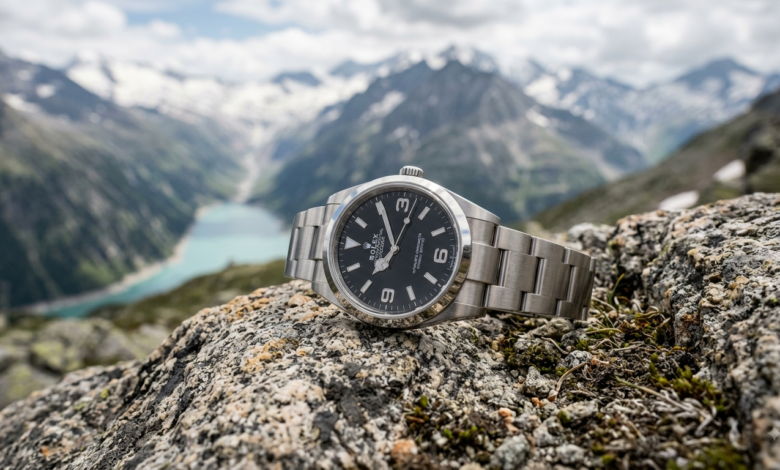
The Rolex Explorer is one of those watches that does not need to shout to get attention. While some luxury watches are instantly recognizable because of their elaborate designs, precious metals, or complicated functions, the Explorer takes a different approach. It is clean, practical, highly legible, and built around the idea of reliability. That understated character is exactly what has made it one of Rolex’s most respected professional watches.
The Explorer has a fascinating connection with exploration and mountaineering. Its design was created around a simple idea: a mechanical watch should remain dependable and easy to read when conditions become challenging. Over the years, Rolex has refined the model without abandoning the qualities that made it successful in the first place.
Today, the Rolex Explorer remains available in two main sizes, 36 mm and 40 mm, with the collection combining traditional design with modern Rolex technology. Current Explorer models use the automatic Calibre 3230, offer approximately 70 hours of power reserve, and are water-resistant to 100 metres.
The History of the Rolex Explorer
The story of the Rolex Explorer is closely connected with the golden age of mountaineering. Rolex has long associated the model with explorers and pioneers who ventured into demanding environments. The watch was designed to represent qualities such as strength, precision, readability, and dependability rather than simply serving as a luxury accessory.
One of the most important moments in the Explorer’s history came in 1953, when the model became associated with the successful ascent of Mount Everest by Sir Edmund Hillary and Tenzing Norgay. Rolex’s relationship with Himalayan exploration helped establish the Explorer’s identity as a watch inspired by people who pushed themselves into extreme environments. The 36 mm case used by today’s Explorer also pays tribute to the proportions of the original model.
What makes the Explorer’s history interesting is that the design did not need to become dramatically more complicated to remain relevant. Instead, Rolex gradually improved the materials, movement, finishing, durability, and legibility. The result is a watch that still looks remarkably faithful to its original concept while benefiting from decades of technical development.
What Makes the Rolex Explorer So Recognizable?
The first thing most people notice about the Rolex Explorer is its black dial. At first glance, it looks extremely simple, but that simplicity is actually one of its strongest characteristics. The dial features the famous Arabic numerals at 3, 6, and 9, combined with luminous hour markers and hands.
Those large 3, 6, and 9 numerals give the Explorer an identity that is difficult to confuse with most other Rolex models. They are not there simply for decoration. Their bold design contributes to the watch’s excellent readability, particularly when the wearer needs to check the time quickly.
The modern Explorer also uses Rolex’s Chromalight display. The luminous material produces a long-lasting blue glow in low-light conditions, helping the hands and hour markers remain visible when the surroundings become dark. Rolex specifically emphasizes legibility as one of the Explorer’s defining qualities.
Rolex Explorer 36 vs. Explorer 40
One of the biggest decisions for someone considering an Explorer today is choosing between the 36 mm and 40 mm versions. The Explorer 36 is especially interesting because its dimensions connect directly with the proportions of the original Explorer. It offers a compact, traditional appearance without feeling outdated.
The 36 mm model can work particularly well for people who prefer a watch that sits comfortably on the wrist and does not dominate an outfit. It also has a versatile character. You can wear it with casual clothing, business attire, or outdoor clothing without the watch looking out of place.
The Explorer 40 provides a more contemporary wrist presence. Its larger case makes the dial feel more spacious, while the familiar black dial and 3-6-9 layout remain intact. Rolex currently lists the Explorer 40 at 40 mm and the Explorer 36 at 36 mm, giving buyers a straightforward choice between traditional proportions and a larger modern format.
The Explorer’s Oystersteel Construction
A major part of the Explorer’s durability comes from its Oyster case and Oystersteel construction. Rolex describes Oystersteel as part of the 904L family of stainless steels and highlights its resistance to corrosion as well as its ability to retain its finish.
This matters because the Explorer is supposed to be more than a watch that stays inside a display box. Its personality is based on being a practical luxury watch that can accompany the wearer through everyday situations. The combination of a strong case, sapphire crystal, screw-down crown, and solid bracelet gives it a reassuring sense of durability.
The Explorer is rated as waterproof to 100 metres, while the screw-down Twinlock crown contributes to the water-resistant construction. The scratch-resistant sapphire crystal also helps protect the dial from everyday wear. These features make the watch considerably more practical than its understated appearance might initially suggest.
The Calibre 3230 Movement
Inside the current Rolex Explorer is the Calibre 3230, a self-winding mechanical movement developed and manufactured by Rolex. It is one of the reasons the modern Explorer is much more than a vintage-inspired design.
Calibre 3230 incorporates several technologies intended to improve reliability and performance. These include Rolex’s Chronergy escapement, blue Parachrom hairspring, and Paraflex shock absorbers. The movement is also designed to resist the effects of magnetic fields and temperature variations, while its architecture is intended to improve shock resistance.
The movement provides approximately 70 hours of power reserve. Rolex also states a precision specification of -2/+2 seconds per day after casing and identifies the Explorer as a Superlative Chronometer. In simple terms, the movement is designed to combine strong accuracy with the durability expected from a modern professional Rolex.
The Famous 3-6-9 Dial
If you had to choose one feature that defines the Rolex Explorer visually, the 3-6-9 dial would probably be the obvious answer. These numerals create an instantly recognizable layout and give the watch a purposeful appearance.
The black background provides strong contrast against the hands and markers. Rather than filling the dial with additional complications, Rolex keeps the Explorer focused on basic timekeeping. There is no date window competing for attention, and there is no rotating timing bezel adding visual complexity.
That minimal approach is part of the Explorer’s appeal. The watch feels balanced because nearly every design element has a practical reason for being there. It is a good example of how a simple watch can still have a highly distinctive personality.
The Oyster Bracelet and Everyday Comfort
The Explorer comes fitted with Rolex’s Oyster bracelet, a design that has become one of the company’s most recognizable bracelet styles. It uses three-piece links and is intended to combine strength with comfort.
The bracelet is fitted with an Oysterlock safety clasp, which helps prevent accidental opening. It also incorporates the Easylink comfort extension system. This allows the wearer to adjust the bracelet length by approximately 5 mm without requiring a separate tool or removing links.
That small feature can make a surprisingly big difference during daily wear. Wrist size can change throughout the day because of temperature, activity, or other factors. Having a quick adjustment available makes the Explorer more practical for someone who intends to wear it regularly rather than only on special occasions.
Why the Rolex Explorer Is So Versatile
The Explorer is arguably one of the easiest Rolex watches to wear with different styles. Its black dial, smooth bezel, and steel construction create a clean appearance that works with jeans and a T-shirt just as naturally as it does with a suit.
That versatility comes from restraint. There are no oversized decorative elements demanding attention, and the watch does not depend on a particular fashion trend. Its basic design has remained recognizable for decades, which gives it a timeless quality.
For someone looking for one luxury watch that can cover many situations, this makes the Explorer especially appealing. It can function as an everyday office watch, travel companion, weekend watch, and formal accessory without requiring the wearer to change watches constantly.
Rolex Explorer 36 and Yellow Rolesor
The Explorer collection is not limited to plain Oystersteel. Rolex also offers the Explorer 36 in Yellow Rolesor, a combination of Oystersteel and 18 ct yellow gold. This version provides a noticeably different personality while keeping the Explorer’s recognizable black dial and 3-6-9 configuration.
Yellow Rolesor brings a little more visual warmth to the model. The contrast between steel and gold gives the watch a more luxurious appearance without completely abandoning the rugged character associated with the Explorer.
For buyers who like the Explorer’s design but want something more distinctive than an all-steel model, the Yellow Rolesor version provides an alternative. Rolex currently lists the Explorer 36 in Oystersteel and yellow gold alongside the Oystersteel versions in its Explorer collection.
Rolex Explorer as an Everyday Luxury Watch
Luxury watches can sometimes feel too delicate or too formal for everyday life. The Explorer takes almost the opposite approach. Its design suggests that it is meant to be worn rather than simply admired.
The 100-metre water resistance, Oystersteel case, sapphire crystal, automatic movement, and secure bracelet all support this everyday character. Of course, any mechanical luxury watch deserves sensible care, but the Explorer is designed with durability as one of its central themes.
This is also why the Explorer can appeal to people who do not necessarily want a flashy luxury watch. Someone might appreciate the quality of Rolex but prefer something understated. In that situation, the Explorer makes a strong argument because its luxury is found more in its construction and finishing than in excessive decoration.
Is the Rolex Explorer Worth Buying?
Whether the Rolex Explorer is worth buying depends heavily on what you want from a luxury watch. If your priority is a complicated movement, a date function, or a visually dramatic design, there are other Rolex models that may suit you better.
However, if you want a simple, recognizable, durable mechanical watch with strong historical roots, the Explorer is difficult to overlook. Its combination of classic proportions, modern movement technology, strong legibility, and everyday versatility gives it a broad appeal.
Another important point is that the Explorer does not rely heavily on changing trends. Its design is intentionally conservative. That can be a major advantage for someone who plans to keep a watch for many years because the model does not depend on a particular fashion moment to look attractive.
What Should You Consider Before Buying a Rolex Explorer?
The first consideration should be size. The Explorer 36 offers a more traditional look and is closely connected to the dimensions of the original Explorer, while the Explorer 40 provides a larger presence on the wrist. Trying both sizes on your wrist is the best way to determine which feels more natural.
The second consideration is material. The Oystersteel version has the most understated and tool-watch-inspired character. The Yellow Rolesor Explorer 36 adds gold and therefore feels more luxurious and visually prominent. Your wardrobe and personal style should play a role in this decision.
Finally, consider how you intend to use the watch. If you want one Rolex that can be worn almost everywhere, the Explorer’s straightforward design is a major strength. If you want something specifically designed for diving, frequent travel timing, or a more complicated display, another model in the Rolex lineup may be more appropriate.
Rolex Explorer Pricing and Availability
Rolex pricing can change by market and over time, so buyers should always check the official Rolex website or an authorized Rolex retailer for current figures. As of the current Rolex listings, the Explorer 40 in Oystersteel is listed at $8,350 USD, while the Explorer 36 in Oystersteel is listed at $7,900 USD. The Explorer 36 in Oystersteel and yellow gold is listed at $14,600 USD on the U.S. Rolex site.
Retail availability is another important part of the buying process. Rolex recommends contacting an official retailer for purchasing and servicing, and the company notes that its authorized retailers have the equipment and technical expertise required to maintain Rolex watches.
For anyone considering a pre-owned Explorer, authenticity and condition become especially important. The watch’s reference number, movement, bracelet, dial, case condition, service history, and documentation can all affect its value. Buying from a reputable source is therefore much more important than simply finding the lowest advertised price.
Final Thoughts on the Rolex Explorer
The Rolex Explorer succeeds because it understands something that many luxury watches sometimes forget: good design does not need to be complicated. Its black dial, 3-6-9 numerals, smooth bezel, Oyster bracelet, and robust case create a look that is both simple and instantly recognizable.
Modern technology has made the Explorer more capable without destroying its original personality. The Calibre 3230 provides approximately 70 hours of power reserve and incorporates Rolex technologies such as the Chronergy escapement, Parachrom hairspring, and Paraflex shock absorbers.
Ultimately, the Rolex Explorer is a watch for someone who appreciates understated luxury. It does not need a complicated dial or an oversized case to stand out. Its appeal comes from the combination of history, engineering, durability, and timeless design.
Whether you choose the traditional 36 mm version, the larger 40 mm model, or the more luxurious Yellow Rolesor configuration, the Explorer remains one of Rolex’s clearest expressions of purpose-driven watchmaking. It is a luxury watch, certainly, but its personality still feels connected to the idea that watches should be useful, reliable, and ready for whatever comes next.