Israel and Palestine: A Complex Conflict, Its History, Human Cost, and the Search for Peace

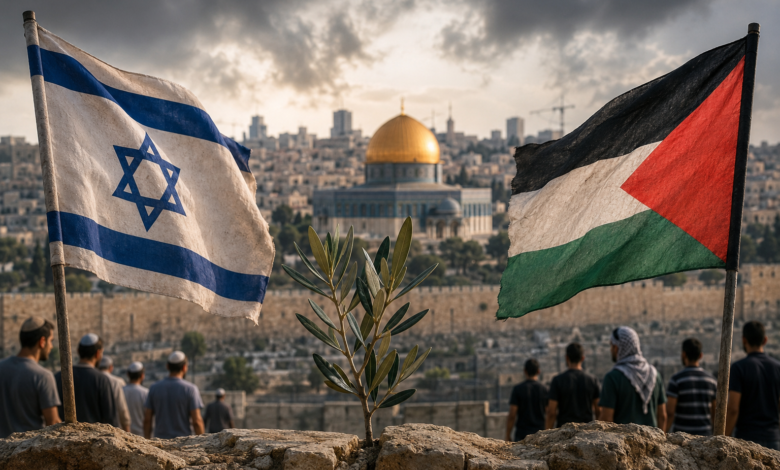
The Israel and Palestine conflict is one of the longest-running and most closely watched disputes in modern history. It is not simply a disagreement over borders. The conflict involves national identity, security, religion, displacement, territory, political power, refugees, and competing historical claims.
For people living far from the region, the subject can sometimes appear difficult to understand because every major event is connected to decades of earlier developments. A military operation, settlement expansion, protest, ceasefire, or diplomatic proposal rarely happens in isolation. Each event is shaped by memories and political decisions that stretch back generations.
The conflict has also produced an enormous human cost. Israelis have experienced wars, terrorism, rocket attacks, displacement, and deep fears about national security. Palestinians have experienced displacement, occupation, restrictions on movement, military operations, settlement expansion, and devastating humanitarian conditions, particularly in Gaza. The human consequences continue to influence how both societies view security and peace.
As of August 2026, the situation remains highly unsettled. Humanitarian conditions in Gaza remain severe, while violence and displacement have also intensified in parts of the West Bank. At the same time, international efforts continue to search for a political arrangement that could provide security for Israelis and meaningful self-determination for Palestinians.
What Is the Israel and Palestine Conflict?
At its core, the Israel and Palestine conflict concerns two national movements seeking political rights and security in the same historic land. Israeli Jews generally view Israel as their national homeland and emphasize the need for a secure Jewish state. Palestinians seek national self-determination and an independent state in the territory they regard as their homeland.
Religion is an important part of the story, but it does not explain everything. Jews, Muslims, and Christians all have deep historical and religious connections to the region. Jerusalem is especially significant because sacred sites associated with Judaism, Islam, and Christianity are located there.
Modern political nationalism transformed the dispute significantly. Jewish Zionism developed partly in response to centuries of antisemitism and persecution in Europe, while Palestinian Arab nationalism developed alongside broader Arab political movements and resistance to foreign rule. These movements increasingly collided during the late Ottoman and British Mandate periods.
The result was a conflict in which both communities developed powerful narratives of belonging, suffering, and survival. Understanding that reality is essential. A serious discussion of Israel and Palestine should recognize the historical experiences of both Israelis and Palestinians rather than reducing the entire issue to a single event or slogan.
The Historical Roots of Israel and Palestine
The modern conflict developed over many decades. After the First World War, the former Ottoman territories were reorganized, and Britain administered Palestine under a League of Nations Mandate. During this period, Jewish immigration increased, particularly as persecution and antisemitism intensified in Europe.
At the same time, the Arab population of Palestine increasingly demanded independence and opposed the growing political project associated with Zionism. Tensions between Jewish and Arab communities became increasingly violent, while British authorities struggled to find a political arrangement acceptable to both sides.
In 1947, Britain referred the Palestine question to the United Nations. The UN proposed partitioning the territory into separate Jewish and Arab states, with Jerusalem receiving a special international arrangement. Jewish political leadership accepted the proposal in principle, while Arab leaders rejected it.
The situation then deteriorated rapidly. Israel declared independence in May 1948, followed by war involving neighboring Arab states. The conflict changed the map dramatically and produced a massive Palestinian displacement known as the Nakba, or catastrophe. The United Nations records that more than half of the Palestinian Arab population fled or were expelled during the 1948 conflict.
The 1967 War and the Occupied Palestinian Territories
Another major turning point came in 1967, when Israel fought Egypt, Jordan, and Syria in the Six-Day War. Israel captured the West Bank, East Jerusalem, Gaza Strip, Sinai Peninsula, and Golan Heights during the conflict.
The war created a new political reality. Palestinians in the West Bank and Gaza came under Israeli military occupation, while the future status of those territories became one of the central questions in the peace process.
UN Security Council Resolution 242 became an important diplomatic reference point after the war. It called for principles including Israeli withdrawal from territories occupied during the conflict and a just settlement of the refugee issue. The precise interpretation of the resolution has remained contested.
The occupation has remained one of the most sensitive issues in Israel-Palestine discussions. Palestinians generally view the occupation as a fundamental barrier to independence, while Israeli governments have repeatedly emphasized security concerns and the need to prevent attacks from territory that could potentially become controlled by hostile armed groups.
Gaza, Hamas, and the West Bank
The Palestinian territories are politically divided. The West Bank is associated with the Palestinian Authority, while Hamas has exercised de facto control over Gaza since 2007 after a violent political split with Fatah.
Gaza is a small and densely populated coastal territory. Israel removed its settlers and permanent ground forces from Gaza in 2005, but Israel continued to control or restrict major aspects of Gaza’s borders, airspace, and maritime access. After Hamas took control in 2007, Israel imposed a blockade, while Egypt also restricted movement through its border.
The West Bank has a different political and security structure. The Palestinian Authority administers certain areas, while Israel maintains extensive military and security control. Israeli settlements have expanded across parts of the West Bank, and their legal and political status remains one of the biggest obstacles in negotiations.
The division between Gaza and the West Bank has also complicated the creation of a unified Palestinian political system. Any future Palestinian state would need to address governance, security, borders, economic links, and political legitimacy across both territories.
Why Jerusalem Matters So Much
Jerusalem holds extraordinary significance for Jews, Muslims, and Christians. For Jews, the city is central to Jewish history and religious tradition. For Muslims, Jerusalem is home to the Al-Aqsa Mosque and the broader Haram al-Sharif/Temple Mount compound. Christians associate the city with major events in the life of Jesus.
Because of this religious importance, political disagreements over Jerusalem often carry an emotional dimension far beyond ordinary territorial disputes. Control, sovereignty, access, archaeology, settlement activity, and the status of holy sites can quickly become highly sensitive issues.
Israel considers Jerusalem its capital and has exercised control over the city since 1967, although the international community has historically treated the city’s final status as a matter for negotiations. Palestinians seek East Jerusalem as the capital of a future Palestinian state.
A durable agreement involving Jerusalem would therefore need to address both political sovereignty and religious access. It would also need arrangements that allow different communities to worship and live securely without turning sacred places into permanent sources of confrontation.
The Humanitarian Cost of the Conflict
The human cost is perhaps the most important part of understanding Israel and Palestine. Behind political speeches and diplomatic negotiations are families dealing with death, displacement, destroyed homes, disrupted education, economic hardship, and psychological trauma.
In Gaza, humanitarian conditions remain extremely difficult in 2026. A UN humanitarian report published on August 14 said that most people in Gaza remained internally displaced and living in harsh conditions, while ongoing military strikes and severe water insecurity continued to affect civilians.
The humanitarian crisis is not limited to food. Water, sanitation, healthcare, housing, electricity, education, fuel, and reconstruction are all interconnected. When infrastructure is damaged, even basic services can become extremely difficult to maintain.
The West Bank also faces serious humanitarian and security concerns. Restrictions on movement, military operations, settlement expansion, and settler violence have contributed to displacement and insecurity. Recent reporting from the region has highlighted attacks against Palestinian communities and growing fears about land and property.
Why Peace Has Been So Difficult
One reason peace has been so difficult is that the major issues are deeply interconnected. Borders cannot easily be separated from settlements. Settlements cannot easily be separated from security. Security cannot easily be separated from Palestinian statehood. Refugees cannot easily be separated from historical responsibility and demographic concerns.
There is also a profound lack of trust. Israelis who have experienced attacks may fear that territorial concessions could create new security threats. Palestinians who have experienced occupation, displacement, and restrictions may fear that negotiations could simply preserve the existing situation without delivering genuine independence.
Political leadership has also changed repeatedly. Governments in Israel and Palestinian politics have shifted between periods of negotiation and confrontation. Armed groups have pursued violent strategies, while governments have often faced domestic political pressure that makes compromise difficult.
Finally, regional and international actors have enormous influence. The United States, Arab governments, European countries, Iran, Turkey, and international organizations all have different interests. Their involvement can help negotiations, but competing priorities can also make a final agreement harder to achieve.
The Two-State Solution Explained
The two-state solution generally means establishing an independent Palestinian state alongside the State of Israel. The idea has been central to international diplomacy for decades.
Under a traditional version of the proposal, Israel would exist as a secure state while Palestinians would establish an independent state in the West Bank and Gaza, with arrangements for Jerusalem and other disputed issues negotiated between the parties.
The concept sounds straightforward, but the details are extremely complicated. Questions include where the border would be, what would happen to Israeli settlements, how Jerusalem would be divided or jointly administered, what security arrangements would exist, and how Palestinian refugees would be addressed.
The United Nations has repeatedly supported a political framework involving Israeli and Palestinian self-determination. Yet the physical and political realities on the ground have become increasingly difficult for negotiators. Settlement expansion, territorial fragmentation, political division, and repeated wars have all reduced confidence that an agreement can easily be implemented.
Current Developments in 2026
The Israel-Palestine situation remains particularly fluid in August 2026. Gaza continues to face severe humanitarian challenges, while diplomatic efforts are attempting to establish a more stable political and security arrangement.
Recent negotiations have focused heavily on Hamas disarmament, Israeli military withdrawal, international stabilization arrangements, and future Palestinian governance. Reports indicate that a US-backed plan has faced disagreement over the sequencing of disarmament and Israeli withdrawal.
This disagreement highlights a recurring problem in peace negotiations: each side wants guarantees before making its own major concession. Israel wants confidence that Hamas will no longer pose a military threat, while Palestinians and international negotiators seek meaningful Israeli withdrawal and a credible political future.
The West Bank has also become an increasingly important part of the current picture. Recent UN discussions have focused on rising violence, settlement-related tensions, displacement, and the danger that developments there could further undermine prospects for a negotiated settlement.
What Could a Future Peace Agreement Look Like?
A realistic peace agreement would probably require more than a simple ceasefire. A ceasefire can stop fighting temporarily, but it does not resolve the underlying political disputes that caused the conflict.
Security would be a central component. Israelis would need credible guarantees against attacks, while Palestinians would need protection from military occupation, settler violence, arbitrary restrictions, and continued displacement. International monitoring could potentially help provide confidence during a transition.
Governance would also matter. Gaza would need functioning civilian institutions capable of delivering healthcare, education, sanitation, housing, and public security. Palestinians would need a legitimate political structure, while Israel would need confidence that neighboring Palestinian territory would not become a base for armed attacks.
Economic reconstruction could become another major pillar. Gaza and the West Bank require enormous investment in infrastructure, housing, healthcare, education, water systems, transportation, and employment. Economic stability cannot replace political rights, but it can make peaceful coexistence more sustainable.
The Importance of Human Rights and Civilian Protection
Regardless of political position, protecting civilians should remain a basic principle. Ordinary people do not control military strategies or diplomatic decisions, yet they frequently experience the consequences.
Israeli civilians have the right to live without fear of attacks, hostage-taking, rockets, or terrorism. Palestinian civilians likewise have the right to life, dignity, humanitarian assistance, freedom from unlawful violence, and a meaningful political future.
International humanitarian law places important obligations on parties to armed conflicts. The protection of civilians, treatment of detainees, access to humanitarian assistance, and distinction between military targets and civilians are central concerns.
A serious conversation about Israel and Palestine should therefore avoid treating civilian suffering as a competition. Recognizing Palestinian suffering does not require ignoring Israeli suffering, and recognizing Israeli security concerns does not require dismissing Palestinian rights.
What the Future of Israel and Palestine Could Mean
The future remains uncertain, but history shows that military power alone has not produced a permanent political solution. Wars have changed borders and political realities, yet the basic national aspirations of Israelis and Palestinians have remained.
For Israelis, the future question is closely connected to security, recognition, national identity, and the fear of renewed violence. For Palestinians, the future is connected to independence, freedom, territorial continuity, refugees, Jerusalem, and the right to determine their own political future.
A sustainable settlement would therefore need to address both sets of concerns. Any arrangement that permanently ignores one population’s fundamental aspirations is unlikely to remain stable.
The international community also faces a difficult challenge. Humanitarian assistance can save lives, but humanitarian aid alone cannot resolve a political conflict. Diplomacy can create agreements, but those agreements require political leaders willing to implement difficult compromises.
Conclusion
The Israel and Palestine conflict cannot be properly understood through one headline, one war, or one political argument. It is the product of more than a century of competing national movements, wars, displacement, occupation, terrorism, political division, settlement expansion, and failed peace efforts.
The historical record contains profound trauma for both Israelis and Palestinians. That trauma continues to shape political decisions and public opinion today. At the same time, civilians on both sides continue to live with consequences that they did not necessarily choose.
In August 2026, Gaza remains in a severe humanitarian crisis, while violence and displacement in the West Bank continue to create new challenges. Diplomatic efforts are still taking place, but major disagreements remain over security, disarmament, military withdrawal, governance, and the long-term political status of Palestinians.
Ultimately, lasting peace would require more than stopping the latest round of violence. It would require a political framework capable of providing Israelis with genuine security and Palestinians with genuine freedom, rights, dignity, and self-determination. Whether that comes through a two-state agreement or another mutually accepted political framework, the central challenge remains the same: finding a way for two peoples with deeply rooted claims to live safely and with political rights in the same land.
The path is difficult, but understanding the history, acknowledging the human cost, and treating the rights and security of civilians seriously are essential starting points for any meaningful discussion about the future of Israel and Palestine.