Finding the Best Trading App can make a real difference in how you manage your investments, follow the financial markets, and make trading decisions. With so many platforms available, choosing the right one is not always easy. Some apps focus on beginners, while others offer advanced charting tools, detailed market analysis, and access to multiple financial markets.
The best choice depends on your experience, financial goals, location, and preferred trading style. An app that works well for a long-term stock investor might not be suitable for someone interested in forex, cryptocurrency, or short-term Best Trading App. Therefore, comparing features before opening an account is a smart first step.
In this guide, you will learn what makes a Best Trading App worth using, which platforms deserve consideration, how trading fees work, and what beginners should know before investing real money. We will also cover security, common mistakes, and practical tips for choosing an app that suits your needs.
Important: Trading involves financial risk, and you can lose some or all of the money you invest. Platform availability, fees, and product access vary by country. Always verify current terms with the official provider before depositing funds.
What Is a Best Trading App?
A Best Trading App is a mobile or desktop application that allows users to buy, sell, and monitor financial assets. Depending on the platform, these assets may include stocks, exchange-traded funds (ETFs), currencies, commodities, bonds, and cryptocurrencies. Some apps focus on a single market, while others provide access to several asset classes through one account.
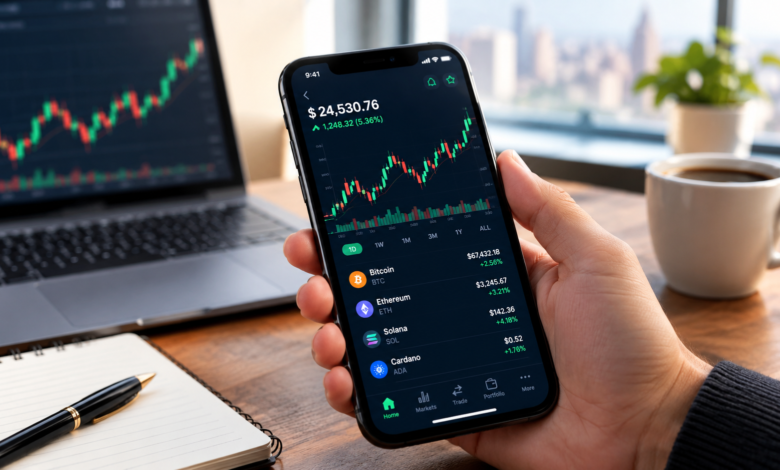
Most Best Trading App offer a dashboard showing account balances, available funds, open positions, and recent transactions. Users can also check market prices, review charts, place orders, and receive notifications about price movements. More advanced applications include technical indicators, economic calendars, and research tools.
Best Trading App have made financial markets more accessible to ordinary individuals. In the past, many investors relied on brokers or desktop-based platforms to manage their portfolios. Today, a smartphone can provide access to a broad range of services, although the availability of those services depends on local regulations and the provider.
However, convenient access does not automatically make trading profitable. Prices can change rapidly, and decisions made without research may lead to losses. A reliable app should help you understand your positions and execute orders efficiently rather than encourage unnecessary trading.
It is also important to distinguish between investing and trading. Investing usually involves holding assets for months or years, while trading often focuses on shorter-term price movements. Some platforms support both approaches, but their tools, fees, and account features may differ.
Ultimately, the Best Trading App is not necessarily the one with the most features or the flashiest interface. It is the platform that provides appropriate market access, transparent costs, strong security, and useful tools for your particular goals.
Best Trading App to Consider in 2026
There is no single Best Trading App that is best for every person. The following platforms are worth comparing because they serve different types of users and trading needs. Their availability and features can vary by country, so confirm that the provider accepts customers from your location.
1. Interactive Brokers
Interactive Brokers is a well-known brokerage platform designed for investors who want access to multiple financial markets. Depending on eligibility and account type, customers may be able to trade stocks, ETFs, options, futures, bonds, and other instruments across international markets.
One of its main advantages is its broad market access. Investors who want to diversify beyond a single country may find this particularly useful. Instead of managing several separate brokerage relationships, eligible customers can potentially access different markets through one provider.
The platform also offers extensive research and analytical tools. Its advanced trading software can support experienced investors who need detailed order controls, portfolio analysis, and sophisticated market information.
However, the number of available features can feel overwhelming to beginners. Users who simply want to buy a few investments and check their balances may need time to understand the interface and available order types.
Costs depend on the market, product, pricing plan, and other account conditions. Investors should examine commissions, exchange fees, currency-conversion charges, and any applicable account requirements before getting started.
Interactive Brokers may suit experienced investors and people interested in international diversification. Nevertheless, beginners should explore the simpler account interface and educational resources before committing funds.
2. Fidelity Investments
Fidelity is a major financial services company offering brokerage accounts, investment products, retirement services, and financial research. Its platform may appeal to people who want to combine long-term investing with occasional trading.
For eligible US customers, Fidelity provides access to stocks, ETFs, mutual funds, and other investment products. The range of available investments makes it useful for people building a diversified portfolio rather than concentrating on a single asset.
Its educational materials and research features can help users understand investment choices. Investors can review company information, examine fund details, and learn more about portfolio construction before placing orders.
Fidelity also offers account management tools that help customers monitor holdings and review their financial activity. These features can be valuable for people who prefer a structured approach to managing money over time.
The main limitation is geographic availability. Fidelity’s standard US brokerage services are not automatically available to residents of every country, and account eligibility must be confirmed directly with the company.
For eligible investors who prioritize long-term investing, educational support, and established brokerage services, Fidelity is a platform worth comparing with other US providers.
3. Charles Schwab
Charles Schwab offers brokerage and investment services for eligible customers, with features that support both everyday investors and more active market participants. Its services include investment research, portfolio management tools, and access to a range of financial products.
One benefit is the combination of brokerage services and educational resources. Investors can research companies, monitor their holdings, and learn about different investment strategies through the platform.
Schwab also offers tools intended for more active traders. The availability of particular features depends on the account and application being used, so users should compare the standard mobile experience with its more advanced trading tools.
As with any brokerage, advertised commission rates do not tell the entire story. Options contracts, regulatory charges, currency conversion, and other transactions may involve additional costs.
Another important consideration is eligibility. Schwab’s US services and international account offerings have different requirements, and not every product is available to every customer.
Charles Schwab may be a strong candidate for investors seeking an established brokerage with research and account-management tools. Before opening an account, review the specific services available to residents of your country.
4. Robinhood
Robinhood is a mobile-focused brokerage known for its streamlined interface and simplified trading experience. Its design aims to make buying and selling eligible investments straightforward for users who prefer managing their accounts from a smartphone.
For eligible customers, the platform offers access to certain stocks, ETFs, and other supported products. The available range depends on the account, product, and applicable regulations.
A major attraction is its relatively simple interface. New users can generally navigate account information and investment listings without learning a complicated professional trading system.
However, simplicity should not be confused with low risk. A quick order process can make it tempting to trade frequently, especially when markets are moving rapidly. Investors should understand what they are buying and why before submitting an order.
Although some transactions may be advertised without commissions, other costs can still apply. Users should check the current fee schedule, account conditions, and product-specific charges.
Robinhood is primarily relevant to eligible US customers and should not be assumed to accept residents of Pakistan or every other country. It may suit beginners who want a straightforward interface, provided they understand the risks and limitations.
5. eToro
eToro is a multi-asset investment platform known for its social investing features and accessible interface. Depending on the user’s location, it may offer access to stocks, ETFs, cryptocurrencies, and other financial products.
Its social features allow users to explore investment ideas and observe the strategies of other participants. Some eligible accounts may also support copy-trading functionality, which can replicate selected investors’ transactions under defined conditions.
This can help users discover different approaches to the markets, but copying another person’s portfolio does not guarantee a positive return. The copied investor may make mistakes, experience losses, or follow a strategy that does not match your risk tolerance.
Users should also understand the precise product being offered. Buying an underlying asset is different from trading a derivative or using leverage, and the distinction can affect ownership, costs, and potential losses.
Fees and availability vary by jurisdiction and product. Spreads, conversion charges, withdrawal fees, and other costs may apply even when a platform advertises commission-free trading for selected assets.
eToro may interest users who value social investing and a visually accessible interface. However, anyone considering it should verify local eligibility, product structure, and current charges before funding an account.
6. MetaTrader 5
MetaTrader 5, often called MT5, is a trading platform that supports advanced charting, technical analysis, automated strategies, and order management. It is widely associated with forex and CFD trading, although the markets available depend on the broker connected to the platform.
Its charting tools allow traders to study price movements using indicators, multiple time frames, and customizable layouts. These features can be useful for people who follow technical trading strategies.
MT5 also supports algorithmic trading through automated programs and custom indicators. Experienced users can develop or use trading systems, but automation does not eliminate market risk or guarantee consistent results.
One important distinction is that MetaTrader 5 is software, not a guarantee that a particular broker is trustworthy. The broker determines the instruments available, account conditions, spreads, leverage, and many other practical details.
This means you should investigate the broker’s regulatory status independently. A professional-looking MT5 interface cannot protect you from an unregulated provider or an unsuitable financial product.
MT5 may be appropriate for experienced traders who need advanced charting or automation. Beginners should learn how orders, leverage, spreads, and stop-loss instructions work before risking real money.
7. TradingView
TradingView is widely used for financial charts, market analysis, watchlists, and trading ideas. It is particularly useful for people who want to study market movements before deciding whether to buy or sell an asset.
Its charting interface offers technical indicators, drawing tools, customizable layouts, and multiple time frames. These features allow users to analyze price trends and compare different assets without switching between several research tools.
Another advantage is its community-oriented environment. Traders can publish market ideas and discuss potential price movements. However, community predictions are opinions, not guarantees, and should be checked against independent research.
TradingView also supports integrations with selected brokers, depending on the market and region. This can allow eligible users to place trades through supported connections, although TradingView itself is not a substitute for checking the broker’s reliability.
Some features are available for free, while advanced functionality may require a paid subscription. Before paying, decide whether you genuinely need additional indicators, alerts, or chart layouts.
TradingView is especially useful for people who prioritize technical analysis. If your main goal is simply to hold investments for years, you may not need its more advanced charting features.
8. Binance
Binance is a cryptocurrency exchange known for offering a broad range of digital assets and trading features. Depending on jurisdiction, its services may include spot trading, advanced charting, recurring purchases, and additional cryptocurrency-related products.
Its market tools can appeal to users who want to compare cryptocurrency prices and manage digital asset positions. More experienced users may appreciate its order options and access to different trading pairs.
However, cryptocurrency markets are highly volatile. A coin’s price can rise or fall sharply within a short period, and smaller digital assets may have limited liquidity or uncertain long-term prospects.
Binance’s fees vary according to trading activity, account level, transaction type, and other conditions. Users should review the applicable schedule instead of assuming that every transaction has the same cost.
Regulatory status and service availability are particularly important in cryptocurrency trading. Some features may be restricted in certain countries, and local rules can change. Check the official service terms and relevant regulatory guidance before depositing funds.
Binance may be worth considering for eligible users who specifically want cryptocurrency trading. It is not a universal stock-trading solution, and anyone using it should understand digital asset custody, withdrawal procedures, and the possibility of substantial losses.
Comparison of the Best Trading Apps
The table below provides a practical starting point for comparing the platforms discussed above. It is a general overview, not a live ranking of prices or a guarantee of local availability.
| Trading app | Best suited for | Main strength | Important consideration |
|---|---|---|---|
| Interactive Brokers | Experienced and international investors | Broad market access | Learning curve |
| Fidelity | Long-term US investors | Research and investment services | Geographic restrictions |
| Charles Schwab | Investors seeking brokerage services | Research and account tools | Eligibility and product-specific costs |
| Robinhood | Eligible US beginners | Simple mobile experience | Limited geographic availability |
| eToro | Social investing enthusiasts | Social and copy-trading features | Fees, risk, and local restrictions |
| MetaTrader 5 | Active technical traders | Advanced charting and automation | Broker quality matters |
| TradingView | Market analysts | Charting and technical analysis | Some features require payment |
| Binance | Cryptocurrency traders | Digital asset trading tools | Volatility and regulatory restrictions |
The right option depends on what you plan to trade. Someone building a retirement portfolio needs different tools from a forex trader who studies price charts every day.
It is also worth remembering that TradingView and MetaTrader 5 are trading tools rather than conventional brokerages in the same sense as Fidelity or Charles Schwab. Their functions and available markets depend on the connected services.
Instead of choosing the app with the most impressive advertisement, compare its actual services with your requirements. A straightforward, affordable platform can be more useful than a complicated one filled with features you will never use.
How to Choose the Best Trading App for Beginners
Choosing your first Best Trading App can feel confusing because almost every platform claims to be easy to use. A better approach is to evaluate a few essential features before creating an account.
Start with regulation and availability. Make sure the provider legally accepts customers in your country and is appropriately authorized for the services it offers. You can verify a broker’s registration through the relevant financial regulator rather than relying on claims displayed on its website.
Next, examine the app’s interface. You should be able to find your account balance, review your holdings, understand order details, and locate the withdrawal process without unnecessary confusion. A simple interface reduces operational mistakes, although it cannot prevent investment losses.
Fees deserve careful attention, especially if you have a small starting balance. A platform might advertise zero-commission trades while charging currency-conversion fees, spreads, withdrawal charges, or other costs. Compare the total expected cost of your actual trading activity.
Look at the educational support available. Good learning materials explain order types, portfolio diversification, market volatility, and the risks of leveraged products. These resources are particularly valuable if you have never invested before.
Security should be another priority. Look for two-factor authentication, account activity alerts, secure login options, and clear policies for protecting customer assets. Never share verification codes or passwords with someone claiming to be a broker’s representative.
Finally, consider whether the app supports your long-term plans. If you want to invest in diversified funds, a cryptocurrency-focused exchange may not meet your needs. If you want to analyze forex charts, a basic stock-investing application may not provide the necessary tools.
Understanding Trading Fees and Hidden Costs
Trading fees can reduce your returns, even when individual charges appear small. Understanding them before opening an account helps you compare platforms fairly and avoid unpleasant surprises.
A commission is a fee charged for executing certain transactions. Some brokers offer commission-free trading on eligible investments, but this does not necessarily mean every service or transaction is free.
Spreads are another cost to understand. The spread is the difference between the buying and selling prices quoted for an asset. In some markets, this difference represents an important part of the cost of entering and leaving a position.
Currency conversion can also affect international investors. If your account operates in one currency and you buy an asset priced in another, the provider may apply a conversion rate or charge a separate fee. Repeated conversions can become expensive over time.
Some accounts have inactivity, withdrawal, transfer, or subscription fees. Others may charge financing costs for positions held overnight, particularly when derivatives or leveraged products are involved. These charges vary widely, so read the provider’s current fee schedule carefully.
Imagine that you deposit a small amount and make several trades each week. Even modest spreads and conversion charges can add up, particularly when your profits are limited. Tracking your actual costs gives you a clearer picture of how your strategy performs.
The most affordable Best Trading App is therefore not necessarily the one with the lowest advertised commission. Look at the total cost of using the platform for the specific assets, transaction sizes, and frequency you expect.
Is Your Best Trading App Safe to Use?
Safety involves more than whether an app works properly or looks professional. It also includes the provider’s regulatory standing, account security, handling of customer assets, and procedures for withdrawing money.
First, check the company behind the app. Search for its legal name and confirm the relevant authorization with the financial regulator responsible for your market. Be careful with websites that imitate legitimate companies or use similar names to confuse customers.
Second, protect your account with a strong, unique password and two-factor authentication. Avoid logging in through suspicious links, and never provide a one-time verification code to someone who contacts you unexpectedly.
Third, understand how customer funds are handled. Depending on the provider and jurisdiction, protections may differ considerably. Deposit insurance, investor compensation schemes, and the segregation of customer assets are not universal and should never be assumed.
Be cautious of guaranteed-profit claims. No legitimate trading strategy can eliminate all market risk, and anyone promising fixed daily returns from risky assets should raise immediate concerns.
You should also test the withdrawal process using the provider’s legitimate procedures before committing a substantial amount. Check withdrawal conditions, identity-verification requirements, processing times, and applicable charges.
Finally, remember that security and investment performance are separate issues. A regulated platform can still offer products that lose value, while a profitable trade does not prove that an unverified provider is trustworthy.
Best Trading App in Pakistan: What Should You Know?
For readers in Pakistan, choosing a Best Trading App requires extra attention to local regulations, account eligibility, and deposit or withdrawal methods. An international platform that accepts customers in the United States or Europe may not offer the same services to Pakistani residents.
If you want to trade shares listed on the Pakistan Stock Exchange (PSX), start by researching licensed securities brokers. Check the Securities and Exchange Commission of Pakistan (SECP) for relevant regulatory information and consult the PSX website for its broker-related resources.
A local brokerage may be more suitable if your primary goal is investing in Pakistani listed companies. Compare its online trading facilities, brokerage commissions, account-opening requirements, customer support, and available research tools before making a decision.
For international stocks, forex, or cryptocurrencies, the situation can be more complicated. Product availability, legal requirements, payment options, and regulatory protections vary. Verify the current rules and the provider’s eligibility requirements before opening an account or transferring money.
Payment convenience should never be your only selection criterion. An app that offers an easy deposit method is not necessarily trustworthy, and you should avoid transferring funds to personal accounts or unfamiliar third parties claiming to represent a broker.
Be especially careful with online groups promising guaranteed forex profits, cryptocurrency signals, or account-management services. Never give another person control of your account simply because they claim to have a successful trading strategy.
The best approach is to identify your intended market first, verify the provider’s legal status, and then compare its costs and features. For Pakistan-based investors, these checks are essential before choosing any international or domestic trading platform.
Best Trading App vs. Investing App: What Is the Difference?
Best Trading App and investing apps often provide similar features, but they can support different financial habits. Understanding the distinction helps you choose a platform that matches your objectives.
Trading generally involves buying and selling assets to benefit from price changes. Some traders hold positions for minutes or hours, while others keep them for several days or months. Trading activity can require regular market monitoring and careful risk management.
Investing usually focuses on building wealth over a longer period. Investors may purchase stocks, diversified funds, or other eligible assets and hold them while considering business performance, valuation, diversification, and long-term financial goals.
A Best Trading App may offer advanced charting, rapid order entry, technical indicators, and price alerts. An investing app may place greater emphasis on recurring contributions, portfolio allocation, fund research, and long-term account management.
Neither approach is automatically better. Active trading requires time, discipline, and an understanding of transaction costs. Long-term investing also carries risk, but it may require less frequent decision-making when implemented through a suitable strategy.
Consider someone who wants to build a portfolio gradually with monthly contributions. A brokerage offering diversified investment options and straightforward account management may be more useful than an app focused on leveraged forex trading.
By contrast, a person who studies technical indicators and trades actively may need more advanced charting and order controls. Define your goal before selecting the software.
Common Mistakes to Avoid When Using a Best Trading App
One common mistake is choosing a platform based entirely on advertising. Promotional offers, attractive interfaces, and claims of easy profits do not establish that a provider is reliable or appropriate for your needs.
Another mistake is trading without understanding the asset. Before placing an order, learn what you are buying, how its price can change, and what could cause you to lose money. Familiarity with an app’s buttons is not the same as understanding the market.
Some beginners also trade too frequently. Constantly buying and selling can increase costs and encourage emotional decisions. A clear strategy with defined objectives may help you avoid reacting to every short-term price movement.
Using leverage without understanding its consequences is particularly risky. Leverage increases exposure relative to the money committed and can magnify losses as well as gains. Depending on the product and applicable protections, losses can occur rapidly and may exceed expectations.
Ignoring diversification is another problem. Concentrating your money in one company, currency, or cryptocurrency exposes you to risks associated with that particular asset. Spreading investments across suitable assets can reduce concentration risk, although diversification cannot eliminate losses.
Finally, avoid investing money you need for rent, essential bills, medical expenses, or other immediate obligations. Markets can decline at inconvenient times, and you may have to sell an investment at a loss if you need cash urgently.
Developing good habits early can make your experience more manageable. Research before Best Trading App, keep records of transactions, review costs regularly, and never allow pressure from online communities to replace independent judgment.
How to Start Trading With Less Risk
If you are new to trading, begin by learning how financial markets operate. Understand basic concepts such as market orders, limit orders, bid and ask prices, liquidity, volatility, and diversification. These concepts can help you avoid preventable mistakes.
Next, select a platform that is authorized for your location and suitable for your intended market. Review its fees, account requirements, security features, and withdrawal procedures before depositing money.
Where available, use a demo account to practice placing orders and reading charts. Demo trading can help you understand how the software works, although simulated results do not fully reproduce the emotions, execution conditions, or financial consequences of live Best Trading App.
Create a written plan before making your first real trade. Identify your objective, the amount you can afford to risk, the conditions under which you would exit a position, and the reasons for entering it.
Keep your initial commitments conservative. You do not need to start with a large balance to learn how a platform operates, and increasing your deposit after a few successful trades does not guarantee continued success.
It can also help to maintain a Best Trading App journal. Record why you entered a position, the fees involved, how you managed risk, and what you learned from the result. Over time, these notes may reveal patterns in your decisions.
Most importantly, treat losses as a possible part of Best Trading App rather than something you can always avoid. Focus on making informed decisions and protecting your financial stability instead of chasing quick profits.
Frequently Asked Questions About the Best Trading App
Which is the best trading app for beginners?
The best option depends on your country and goals. Beginners should prioritize regulatory compliance, transparent fees, a simple interface, useful educational resources, and reliable account security.
Which Best Trading App is best for stocks?
Interactive Brokers, Fidelity, and Charles Schwab are worth comparing for eligible investors. Their suitability depends on market access, account eligibility, investment choices, and fees.
Which Best Trading App is best for cryptocurrency?
Binance is one platform to research for cryptocurrency trading, subject to local availability and applicable regulations. Compare custody arrangements, Best Trading App fees, supported assets, and withdrawal procedures before using any exchange.
Can I start trading with a small amount of money?
Some platforms permit small initial deposits or fractional investments, depending on the product and jurisdiction. However, check minimums and transaction costs because fees can have a larger proportional impact on small balances.
Are commission-free trading apps really free?
Not necessarily. Even when eligible trades have no commission, you may still pay spreads, currency-conversion fees, subscription charges, financing costs, or other applicable fees.
Is online trading safe?
Online trading can be conducted through legitimate, appropriately regulated providers, but it always involves risks. Check the provider’s authorization, enable account security features, and understand the product before investing.
Can I use international Best Trading App in Pakistan?
Availability depends on the company, account type, financial product, and current regulations. Verify eligibility directly with the provider and consult relevant Pakistani regulatory guidance before depositing funds.
Is a Best Trading App better than a desktop platform?
A mobile app is convenient for monitoring investments and placing orders while away from a computer. Desktop platforms may provide more screen space and advanced analytical tools. The better option depends on your Best Trading App style.
Final Thoughts
Choosing the best Best Trading App is about finding a trustworthy platform that fits your financial goals, experience, location, and budget. Interactive Brokers may appeal to international investors, Fidelity and Charles Schwab offer options for eligible US customers, Robinhood focuses on a simplified trading experience, and eToro emphasizes social investing. Meanwhile, MetaTrader 5 and TradingView provide tools for technical analysis, while Binance focuses on cryptocurrency markets.
Before making a decision, compare the provider’s regulatory status, available assets, total fees, security measures, and withdrawal conditions. If you live in Pakistan, pay particular attention to whether the service is available to you and complies with relevant requirements.
Remember that a sophisticated app cannot replace financial knowledge or guarantee successful trades. Start by learning the basics, consider practicing with a demo account, and only risk money you can afford to lose.